Main

November 27, 2008

5 Things To Be Thankful For In This Market (Part 4)

Source: Flickr by Egan Snow; http://www.flickr.com/photos/egansnow/343535886/

Over the last week or so I have been listing things to be thankful for in this market. So far I have covered three things. They are:

1. The Teachings of Benjamin Graham

2. Low P/E Ratios

3. The Inevitable Market Rebound

And now I am listing numbers 4 and 5:

4.     Black Eyed Peas, and
5.     Collard Greens

Seriously, do I really need to say more? There are few things in life that beat mom’s collard greens and pop’s black eyed peas thrown in with a little Jamaican corn bread. And with today's economy and the burden it is putting on the pocket book, a cheap meal is hard to come by. In fact, with Americans on food stamps reaching an all-time high, a cheap nutritious meal is just what the doctor ordered.

Southern folklore suggests, that a meal of black eyed peas and collard greens will bring with it good luck and financial prosperity. The peas represent coins and the greens represent folding money. Both foods are dependable sources of nutrients and antioxidants that protect your heart and maybe prevent cancer and both are great sources of folic acid.

So in the spirit of Thanksgiving and my hope we can all get a little more luck and wealth in our lives, I have decided to share a recipe from the Homesick Texan for black eyed peas:

http://homesicktexan.blogspot.com/2006/12/black-eyed-peas-for-new-years-day.html

And another for collard greens from Ms. Financial Savvy:

http://www.msfinancialsavvy.com/article.php?aId=141 

Good eats and Happy Thanksgiving!

Disclosure: I do not, nor do the clients of Brick Financial Management, LLC, own any securities mentioned in this article. But positions may change at any time.

 Subscribe: Email | Reader | RSS | Audio | IPOD | Mobile Alerts
| Email this Email This | Digg! This Digg | Bookmark to Delicious Delicious | Reddit This Reddit | Search Technorati Technorati | Facebook | Post to MySpace!MySpace! | Print This Print

September 30, 2008

What You Should Do In This Market

Perhaps you have been startled by what has been going on in the stock market this year, and in the last few days in particular. It is understandable if you have been. This is an unusual time. There’s a lot of uncertainty in the financial sector. Bear Stearns and Lehman have failed, Fannie Mae and Freddie Mac have been taken over by the government, AIG had to take accept an $85 billion loan from the government with steep terms, Morgan Stanley and Goldman Sachs converted to conventional banks, the FDIC stepped in to save Wachovia and Washington Mutual, and the Treasury Department is asking Congress to pass a $700 billion bailout of the financial system.

If you watched any news program or read any paper yesterday you know that Congress did not pass the plan proposed by the Treasury. The stock market reacted. Yesterday, the S&P 500 fell 8.9%. As a relative measure, the day the market opened after the tragedy of September 11, 2001, the S&P fell 4.9% on September 17, 2001. It was the biggest one day drop since Black Monday in October of 1987 when the market fell more than 20% in one day.

All of this turmoil is likely to leave most investors in the market biting their nails and pulling their hair out. These folks, not knowing what to do, will do nothing. Others might react by immediately selling all their investments, pulling their money out of their bank, and burying everything they own under the shed in their backyard. I understand both reactions, as both are simply human. But neither is what should be done.

As you have heard (or read) me say time and time again, it is best to act in the way Warren Buffett would. In Berkshire Hathaway’s 2004 Letter to Shareholders, he shares:
“Over the 35 years, American business has delivered terrific results. It should therefore have been easy for investors to earn juicy returns: All they had to do was piggyback Corporate America in a diversified, low-expense way. An index fund that they never touched would have done the job. Instead many investors have had experiences ranging from mediocre to disastrous.

There have been three primary causes: first, high costs, usually because investors traded excessively or spent far too much on investment management; second, portfolio decisions based on tips and fads rather than on thoughtful, quantified evaluation of businesses; and third, a start-and-stop approach to the market marked by untimely entries (after an advance has been long underway) and exits (after periods of stagnation or decline). Investors should remember that excitement and expenses are their enemies. And if they insist on trying to time their participation in equities, they should try to be fearful when others are greedy and greedy only when others are fearful.”

Recently, Buffett invested $5 billion in Goldman Sachs on very favorable terms. He did so in the midst of all the turmoil in the financial sector of the market. In essence, he followed his own advice.

This method of buying into fear has proven fruitful over time. How does an investor know when others are fearful?

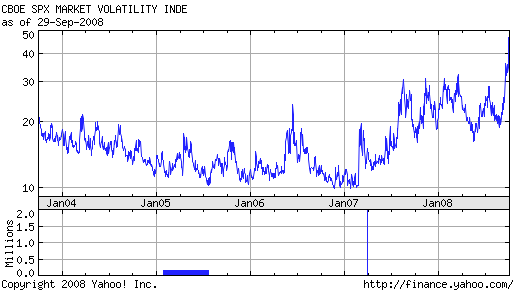
The Chicago Board Options Exchange (CBOE) manages a volatility index called the VIX. The VIX is an excellent indicator of the sentiment, bearish (fearful) or bullish (greedy), in the stock market. It captures the level of uncertainty reflected in option contract premiums. These contracts allow fund managers to insure themselves against sudden share price movements. A high VIX reading indicates investors are fearful and are willing to pay more for this downside protection.

History has shown that when the VIX reaches levels above 25 – 30 (above the red line), it has been a good time to buy. Yesterday the VIX reached nearly 50 and for the last 18 months has regularly reached levels above 25. [Click here for a larger image.]

Click to see larger image

Additionally, we are in a bear market for stocks. The likelihood of precipitous declines from these levels is somewhat low (though not impossible). Given current valuations, U.S. stocks may be the safest place to put money right now. The S&P 500 now trades at 14x earnings estimates for 2008 EPS. This is well below historical PE levels. Another thing to keep in mind is earnings may be somewhat depressed due to a harsh economy. In other words, when earnings return to normal, prices may prove to be even cheaper than it is currently estimated.

High volatility begets cheaper stocks which begets high returns for those who are greedy when others are fearful. 

So what should you do now?

For money you need within 5 years: Keep those funds in an interest bearing account at your bank of choice. Even with all that is going on, the bank is still the best option for your cash funds. If those deposits are below $100,000 ($200,000 in a joint account), they are insured by the FDIC. And the news today is the FDIC is applying to increase those limits. I speculate they will increase them to at least $250,000. 

For money you need beyond 5 years: Invest or keep your money in a diversified (at least 20, no more than 30) portfolio of stocks of low leverage (companies that don’t make use of debt), high return on capital companies. If you have cash available, you should consider adding to your portfolio. Years from now, you will wish you did.

Write your congressman: Write your congressman a letter urging him or her to pass the legislation to infuse $700 billion in the banking system.

Disclosure: I and the clients of Brick Financial Management, LLC owned share of Berkshire Hathaway at the time of this writing.

 Subscribe: Email | Reader | RSS | Audio | IPOD | Mobile Alerts
| Email this Email This | Digg! This Digg | Bookmark to Delicious Delicious | Reddit This Reddit | Search Technorati Technorati | Facebook | Post to MySpace!MySpace! | Print This Print

September 02, 2008

10 Signs Your Financial Advisor Is Stealing Your Money (Part 1)

Hope everyone had a wonderful Labor Day weekend. The weather in the Northeast was great and considering how bad things could have been, Gustav thankfully spared most of New Orleans. As well as enjoying the weather I was able to watch the U.S. Open, take in the movie The Longshots (you know for the kid) followed up with a visit to the park and was able to catch up with old and new friends online (there’s this new thing called social media…).

In catching up with one of those friends, we got to talking about investing and personal finances. Big surprise right? She alerted me to a story of which I was unaware at the time. The story was simultaneously tragic and unbelievable. When I went to Google to read more about it, it then became all too familiar. What I found was yet another story of fraud and deception and the stealing of investor money.

As I read more of the details of this particular yet hardly unique story, the warnings signs seemed so clear to me. I thought to myself, “Some of these investors should have known better!” But alas, even so-called sophisticated investors can be had. No one is immune from making mistakes or getting taken by a sophisticated or savvy charlatan (like the one in the video).

All that said there are steps that can be taken to protect yourself from dishonest (or just plain bad) financial ‘professionals”. It is as important to know what makes a bad financial professional as it is a good one. In at least another two follow up posts I will cover warning signs that should alert any investor their advisor may not be on the up and up.

Have you had a not so pleasant experience with a financial professional? Share it in the comments are of this post.

 Subscribe: Email | Reader | RSS | Audio | IPOD | Mobile Alerts
| Email this Email This | Digg! This Digg | Bookmark to Delicious Delicious | Reddit This Reddit | Search Technorati Technorati | Facebook | Post to MySpace!MySpace! | Print This Print

August 27, 2008

5 Ways to Handle Your Personal Trade Deficit

An interesting documentary called “I.O.U.S.A.” premiered August 22nd in a few cities around the country. According to the filmmakers, the country is on the brink of a financial meltdown. I.O.U.S.A. examines the national debt and its consequences for the United States and its citizens. The subject of America’s financial woes is a subject Warren Buffett, who is featured in the movie, has tackled in the past.

Although I have not seen the movie, I will definitely check it out. In the meantime the folks at The Peter G. Peterson Foundation offer some advice on how to handle your personal financial deficit:

  1. Establish a personal budget

  2. Create a financial plan that considers your long-term financial objectives, major milestones in your life and what you will need in retirement.

  3. Act on that financial plan immediately.

  4. If you must use credit, use it responsibly.

  5. Pass on what you have learned to your children.


 Subscribe: Email | Reader | RSS | Audio | IPOD | Mobile Alerts
| Email this Email This | Digg! This Digg | Bookmark to Delicious Delicious | Reddit This Reddit | Search Technorati Technorati | Facebook | Post to MySpace!MySpace! | Print This Print

August 26, 2008

5 Ways to Use Your Friends for Fun and Profit

Credit: http://www.flickr.com/photos/britannia/2471752889

I recently received an email from a college buddy and former football teammate regarding our alma mater’s upcoming fall classic with our school’s arch rival. Yes, I played college ball and have the knees to prove it. About fifty of my former teammates and some boosters of the program were on the email string. Basically, along with regular guy talk and crude remembrances of embarrassing moments long gone, there was the point of the email which was to organize hotel reservations and a tailgate party for the weekend of the upcoming game.

My buddy who initiated the email, the resourceful guy that he is booked 20 rooms at a local hotel to ensure any of us who wanted to go would have a cheap room to stay. Not to mention a place to crash after too much beer and bratwurst at the tailgate. But the email got me to thinking of other ways to have fun and profit by banding together with others.

1. Group Discounts

I just mentioned one form of group discount - savings on hotel and travel. But group discounts do not have to be reserved to destination weddings and weekend hotel reservations for the big game. Discounts can be had in almost any situation. Want a little nip and tuck? Get a couple of friends together and have your surgery on the same day with the same doctor. Want to save on insurance rates? Often groups such as employers, alumni associations and other clubs have worked out group discount rates with a particular insurance agency.  You might save anywhere from 5-20% as a result of a group rate discount.

2. Investment Clubs

Joining an investment club seems so ‘90s. The costs of investing in the stock market have dramatically fallen over the last decade and financial news and information seems like it’s everywhere. This blog is a good example. However, significant costs to investing still exist. Investment clubs help to spread those costs over several individuals. However, this is not the only benefit to joining or forming a club. Besides the money cost benefits, are the educational and social benefits of the club. You may find your club mates saving you from costly investment mistakes you may have made on your own.

3. Price Clubs

Discount price clubs, like Sam’s Club a division of Walmart (WMT), BJ’s Wholesale (BJ) and Costco (COST), offer a prime opportunity to save on purchases made repeatedly. The stores essentially allow you to pool your consumer dollar with a few million of your like minded “friends”. The result is googobs of savings. I have belonged to Costco for a number of years and recover my membership fee within the first few purchases of bottled water, chicken breasts and orange juice.

You can even take this a little further by starting a bulk-buying co-op with your friends and neighbors. Basically, you can share your or share someone else’s membership. Whenever one of you makes a trek to the club, you simply double, triple or quadruple buy your items and distribute them amongst your partners. Although doing it this way may cut down on your fun quotient, it will definitely up the savings quotient.

4. Carpools

I hate carpools. Not because they don’t save money but they can be a little inconvenient. That said, I have always opted to either drive myself or alternatively, have taken public transportation to work. But for many, carpooling makes sense. If you find yourself driving 15 or more miles to work everyday and you live within 2 to 5 miles of a coworker or two, you should consider sharing a ride.

According to the Department of Energy, as of today (August 25th) a gallon of gas is $3.69 per gallon. A quick calculation says a person that works 15 miles from work and whose car gets $20 miles to the gallon will spend almost $1,400 per year simply traveling to and from work. Feel free to check my math. With budgets tight it seems to make sense to spread those costs to three others if you can. Besides saving money and the environment you will be cutting down on the frequency of your road rage, given you will now be sharing the driving duties.

5. Team Sports

Ok, ok. Ya got me. Some of these things do not necessarily seem all that fun. But they will save you time and money in most cases. So number 5 will be all about using the money you have saved and the time you have freed up to simply have some fun. Why not participate in a team sport? Try a bowling league or a softball team. And let us not forget one of the greatest team sports there is – roller derby! With team names like the Hissy Fits, how could it not be fun?

Disclosure: I and the clients of Brick Financial did not own shares of any of the companies mentioned in this article at the time of this writing.

 Subscribe: Email | Reader | RSS | Audio | IPOD | Mobile Alerts
| Email this Email This | Digg! This Digg | Bookmark to Delicious Delicious | Reddit This Reddit | Search Technorati Technorati | Facebook | Post to MySpace!MySpace! | Print This Print

Subscribe with: 

Subscribe in a readerSubscribe By Email:
-- subscribe to get updated headlines and full length posts delivered right to your email address.


or subscribe by:

Reader | RSS | Audio | IPOD | Mobile

About Brick Financial Management, LLC

Blogged by Brick Financial

51 JFK Pkwy, 1st Fl. West
Short Hills, NJ 07078
973-486-9860
Email Us

Brick Financial Management, LLC is a Registered Investment Advisor specializing in providing investment management services to individuals, families, organizations and institutions. We implement highly focused stock, bond, and balanced portfolios using an investment approach commonly referred to as value investing.

Share

ShareThis -- ShareThis lets you instantly access all of your profiles, blogs, friends, and contacts for easy sharing and updating on sites like Digg, Delicious, Reddit, Facebook and MySpace. For more about ShareThis, click here.

Digg! Digg -- submit this item to be shared and voted on by the digg community. For more about digg, click here.

Delicious Del.icio.us -- mark an item as a favorite to access later or share with the del.icio.us community. For more about del.icio.us, click here.

Facebook Facebook -- share an item with users of Facebook, a collection of school, company and regional social networks. For more about Facebook, click here.

Ben's Latest Tweet

    Follow Ben on Twitter

    Archives