Main

March 09, 2009

10 Signs Your Financial Advisor Is Stealing Your Money (Part 2)

Bernard Madoff
Source: Reuters

Today Warren Buffet appeared on CNBC for 3 hours answering a multitude of questions from Becky Quick, Joe Kernen and a slew of emailers. One emailer from Cincinatti asked "How do we know that you are not another Bernie Madoff?" In response Buffett said:

"Well, that's a good question. I would say this. I--it is a problem with investment advisers. I mean, it--there are going to be a certain number of crooks in the world. And sometimes they're smooth-talking, and the best ones are the ones that kind of don't look like crooks... it is a problem who you put your trust in."

He then later agreed with Joe Kernen that an investor cannot rely totally on government regulation to catch these crooks. So what is an investor trying to protect herself to do?

I wrote a post (Part 1) back in September of last year with the intention of answering this question. This was before the Bernie Madoff or the R. Allen Stanford stories broke. In the post I promised 10 red flags which might alert an investor that his advisor is not on the up and up. I'm finally getting around to listing them. Today I'll do just a couple and get to the rest at a later date.

As a side note, The Wall Street Journal reports that the client list of Bernie Madoff became available to the public. The list contains well known and not so well known folks running the wealth spectrum. The one thing they all have in common is they are all considered sophisticated investors. The list should once and for all prove that "sophisticated" means little in the investment world and underscores my personal pet peeve with the restrictive accredited investor law. I digress.

1. Returns that (nearly) always go up:

If your advisor is reporting returns that always seem to go up, then you should regard his numbers with great skepticism. The markets are controlled by unpredictable human emotion and its movements simply can't be predicted. Madoff's firm produced returns of positive 1% to 2% in gains per month with only five negative months covering a period of 12 years. These types of returns are so improbable that an investor can almost stop here and safely speculate that they've encountered a ponzi scheme or at least an investment manager that is not telling the truth about his returns. But we'll go on.

2. Complex strategies that cannot be duplicated:

When and an advisor has to start using greek letters in formulas to explain his investment strategy, it's time to be concerned. Madoff used an investment strategy consisting of purchasing blue-chip stocks and then taking options contracts on them - a split-strike conversion or a collar. The strategy itself is not complicated. In fact, it's pretty plain vanilla. What was extraordinary are returns Madoff reportedly received with the strategy.

A few individuals attempted to perform due diligence but were unable to replicate the Madoff's past returns. Harry Markopolos was among those that tried. In an interview with 60 Minutes he said:

"As we know, markets go up and down, and his only went up. He had very few down months. Only four percent of the months were down months. And that would be equivalent to a baseball player in the major leagues batting .960 for a year. Clearly impossible. You would suspect cheating immediately... No one's that good."

The above represents a stark contrast to the investment approach employed by Mr. Buffett - value investing. Unlike the method employed by Mr. Madoff, it is niether complex nor does it produce returns that are always favorable. In fact, sometimes years go by without positive results. That's why it is so important to have a long term view as Buffett reiterated today in his interview with CNBC.

BECKY: Yeah. And on a serious note, there are people who look at the stock market and wonder how do they know the whole thing's not a Ponzi scheme?

BUFFETT: Well, the whole thing's not a Ponzi scheme.

BECKY: What--how do they know who to trust?

BUFFETT: We're talking about, you know--we're talking about American businesses that employ, just the ones on the stock market, tens and tens and tens of millions of people. They're real companies... in the 20th century, the Dow went from 66 to 11,000, you know, 400. And we had all kinds of problems during that period. Business works overall. It doesn't work every day or every week or every month, and sometimes it really gets gummed up. And then you need government invention sometimes to get the machines back working smoothly. But the machine works.

JOE: Warren...

BUFFETT: And equities, over time, are the way to do it.

Disclosure: none.

 Subscribe: Email | Reader | RSS | Audio | IPOD | Mobile Alerts
| Email this Email This | Digg! This Digg | Bookmark to Delicious Delicious | Reddit This Reddit | Search Technorati Technorati | Facebook |

', 'http://www.brickfinancial.com/thethirdpig/archive/2009/03/10_signs_your_financial_adviso_2.html', 4)"> Post to MySpace!MySpace!
| Print This Print

February 14, 2009

Are We Still In A New Bull Market?

View video on The Third Pig or YouTube

Last month I posted and videoed about whether or not we were in a bull market based on five market indicators. I said that one way to tell if we’re in the beginning of a bull market is to try to ascertain whether or not we had seen a bottom. I concluded that we had seen a bottom in the market (November 20th, 752 level in the S&P 500) and that we’re in a new bull market trend. Today I’d like to look at another three:

1. Worst GDP decline in 25 years

On January 30, 2009, the BEA reported that GDP shrank 3.8% in the 4th quarter of 2008 (chart below). This was the worst showing in 25 years. The last time the economy shrank this severely was the 1st quarter of 1982. What did the market do the day these figures came out? It declined 2.2%, falling from 845.1 to 825.9. Not much of a move considering the news.

2. Job losses skyrocketing and unemployment trending toward double digits

February 5, 2009, the Labor Department reported 598,000 were lost bringing the total since the beginning of 2008 to 3.6 million. The unemployment rate went up to 7.6% making it the highest it’s been in decades. What did the market do that day? It went up 2.7% from 845.9 to 868.8.

3. Market price to GDP ratio

Back in 2001, in a Fortune magazine article Warren Buffett presented a chart comparing the total market value of U.S. based business as a percentage of GNP. An update of that chart is presented below. In the article Buffett said, “If the percentage relationship falls to the 70% to 80% area, buying stocks is likely to work very well for you." Currently this ratio sits below 75%.

I compared the market value of U.S. equities using the Wilshire 5000 index which comprises all stocks traded on the major exchanges in the U.S. I then compared it to GDP, a decent proxy for GNP. At the November 20th low, the percentage relationship between the two figures was 64% (Wilshire 5000 = 7.4 trillion and GDP = 11.7 trillion) and by the end of December remained below 80%.

Even if the market breaks through the 800 level, which who knows, it might, I am still on the side of this being a new bull market.

Disclosure: I and the clients of Brick Financial Management, LLC are own shares of iShares S&P 500 Index ETF but positions can change at anytime.

 Subscribe: Email | Reader | RSS | Audio | IPOD | Mobile Alerts
| Email this Email This | Digg! This Digg | Bookmark to Delicious Delicious | Reddit This Reddit | Search Technorati Technorati | Facebook | Post to MySpace!MySpace! | Print This Print

February 13, 2009

"You Ought To Be Rich" at the Tao of Talani

Tao of Talani
Source: Tao of Talani

I would like to make you aware of a great new blog I think will be of interest to many of you who read The Third Pig. It is the Tao of Talani. In the About section of the blog you'll find Talani's story. He writes:

How does a skinny New York City kid grow up to rub elbows with Will Smith, Magic Johnson, Denzel Washington, CEO's, Politicians and other prominent figures? Simply, never define anything as IMPOSSIBLE. I didn't mention high profile names to impress but to impress upon you that anyone can create there reality.

He goes on to tell us his purpose for the blog:

In The TAO OF TALANI blog I share my experiences as a humble student, emphasizing there is no wrong or right way to achieve your goals. The blog is specifically designed for self-empowerment, entrepreneurs and lifehackers seeking to create a productive new reality. My objective is to be an asset to the collective by sharing knowledge from leading thinkers and doers.

Tuesday I contributing a post to the Tao of Talani titled, "You Ought To Be Rich". The post provides 10 simple but admittedly not easy steps to follow toward wealth. Please visit the blog and leave a comment there, or here, and let me know what you think.

Disclosure: none

 Subscribe: Email | Reader | RSS | Audio | IPOD | Mobile Alerts
| Email this Email This | Digg! This Digg | Bookmark to Delicious Delicious | Reddit This Reddit | Search Technorati Technorati | Facebook | Source: Tao of TalaniI would like to make you aware of a great new blog I think will be of interest to many of you who read The Third Pig. It is the Tao of Talani. In the About section...

', 'http://www.brickfinancial.com/thethirdpig/archive/2009/02/you_ought_to_be_rich_at_the_ta.html', 4)"> Post to MySpace!MySpace!
| Print This Print

October 28, 2008

Greed (When Others Are Fearful) Is Good

Source: The Digerati Life, thedigeratilife.com

Buffett’s Detractors
Warren Buffett has had his share of detractors since his New York Times Op-Ed piece in which he announced he would be buying American stocks in his personal account. According to Buffett, “…fears regarding the long-term prosperity of the nation’s many sound companies make no sense… But most major companies will be setting new profit records 5, 10 and 20 years from now.”  

The crux of the detracting argument is Buffett’s call is untimely, he is too rich to worry about asset allocation or time horizons and you, we are not him. Dianne Francis of Canada’s National Post sums up this viewpoint:

"…guys like Warren Buffett also operate in a parallel universe of Cash-Rich, Long-Term, Value Investing. He’s making big bets on American stocks. We should not for lots of reasons. He's just plain wrong and I wrote about that yesterday. The stock markets are not capable of being a valid pricing mechanism for anyone for some time. Besides that every day brings more bad news, and new developments.”

Seems to me the detractors have cherry-picked certain lines from Buffett’s piece. Buffett in no way suggested the near term picture would be pretty. In the near term, markets are likely to continue their record breaking volatility and investors may suffer yet more loses. Buffett wrote,

  • “In the near term, unemployment will rise, business activity will falter and headlines will continue to be scary.”
  • “To be sure, investors are right to be wary of highly leveraged entities or businesses in weak competitive positions.”
  • “…businesses will indeed suffer earnings hiccups, as they always have.”
  • “Let me be clear on one point: I can’t predict the short-term movements of the stock market.”

But Buffett’s qualifying statements are beside the point. His overall point was clearly missed or ignored - due to the widespread fear in the marketplace, stocks of strong businesses are cheap. And, in the long term, these businesses are likely to grow through economic booms and busts. Since, in the long term, stock prices are highly correlative to the performance of businesses, it makes sense to buy when the prices of stocks are below the value of the underlying businesses. That time, according to Buffett, is now.

The Typical Investor Buys High and Sells Low
Buffett goes on to point out the resiliency of the market. He also emphasizes most investors’ uncanny ability to miss out on those gains because of their tendency to buy when they are comfortable (at market tops) and sell when they are fearful (at market bottoms). To underscore Buffett’s point, consider the following:

Research conducted by DALBAR, Inc shows for the 20-year period ending December 31, 2007, the typical mutual fund investor failed to capture the returns of the market. Although the average mutual fund trailed the market by about 2.5%, during this 20-year period, the typical mutual fund investor received a return of 4.48% while the market returned 11.82%. In fact, the investors’ returns were barely above the rate of inflation which clocked in at 3.04% during the period. 


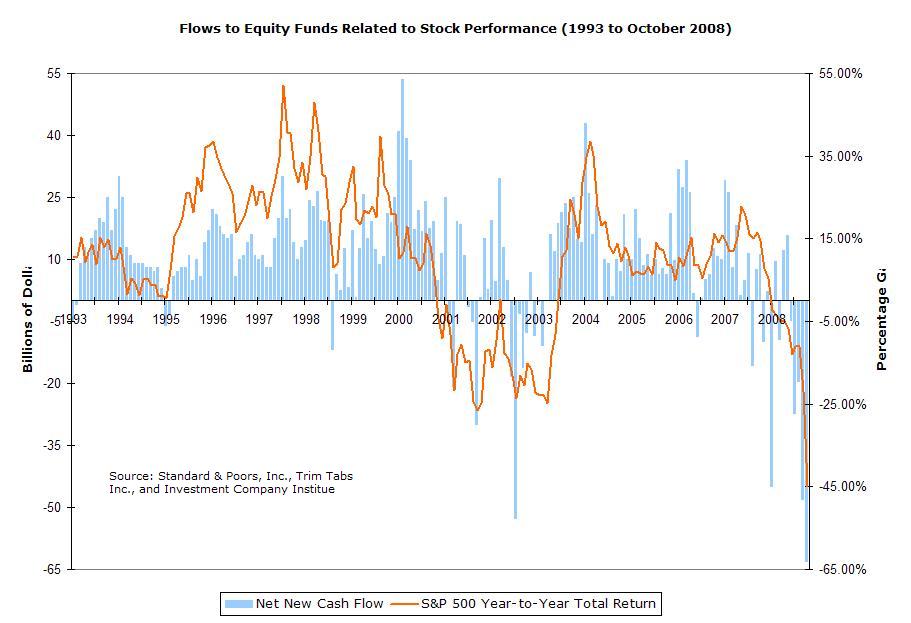
The disappointing results received by equity investors is totally due to the manic depressive buying and selling described by Buffett. As the chart below demonstrates, investors sell their mutual fund shares [demonstrated by the downward blue bars] just when market performance deteriorates [demonstrated by the orange line in negative territory].
Click for larger image 

When Ms. Francis suggests the market is a “valid pricing mechanism” she demonstrates, as do her fellow Buffett detractors, she does not understand that price and value are not the same. In the short term, stocks markets are never valid pricing mechanisms. Investors who believe otherwise allow their emotions to dictate their investment timing, a sure way to diminish investment results as the chart/table above demonstrate.

Investors Make Easy Things Difficult
Buffett has given the world one of his golden rules to investing: Be greedy when others are fearful and fearful when others are greedy. In fact, one might say this is the definition of value investing. However, as Buffett noted in his 1984 essay “The Superinvestors of Graham-and-Doddsville” there are not likely to be many converts to the practice. He writes,
“Adding many converts to the value approach will perforce narrow the spreads between price and value. I can only tell you that the secret has been out for 50 years [now over 75 years], ever since Ben Graham and David Dodd wrote Security Analysis, yet I have seen no trend toward value investing in the 35 years I have practiced it. There seems some perverse human characteristic that likes to make easy things difficult… There will continue to be discrepancies between price and value in the marketplace, and those who read their Graham and Dodd will continue to prosper.

I’ll be re-reading my Graham and Dodd.
 

Disclosure: none

 Subscribe: Email | Reader | RSS | Audio | IPOD | Mobile Alerts
| Email this Email This | Digg! This Digg | Bookmark to Delicious Delicious | Reddit This Reddit | Search Technorati Technorati | Facebook | Post to MySpace!MySpace! | Print This Print

October 13, 2008

What Goes Up Must Come Down... And Up Again

Benjamin Graham’s proverbial Mr. Market is manic depressive and thusly causes much of the daily up, then down, then up again movements in stock prices. When pessimism pervades, Mr. Market will be so eager to sell his shares he will eagerly drive down stock prices to levels that make little sense. We saw Mr. Market do that over the last couple of weeks, driving the S&P 500 down 28% in just 14 days.

Mr. Market was so depressed in fact and so willing to sell, the CBOE VIX Index reached record proportions, topping 50 for the first time since it started measuring all 500 stock of the S&P Index. However, in his haste, Mr. Market has thrown the baby out with the bath water. Values abound as an article in the Wall Street Journal by Jason Zwieg points out:

“Out of 9,194 stocks tracked by Standard & Poor's Compustat research service, 3,518 are now trading at less than eight times their earnings over the past year -- or at levels less than half the long-term average valuation of the stock market as a whole. Nearly one in 10, or 876 stocks, trade below the value of their per-share holdings of cash…”

Zwieg also points to a Benjamin Graham measure of valuing the stock market adopted by Yale professor, Robert Shiller, is at its lowest levels since 1989. The Graham P/E divides the price of major U.S. stocks by their net earnings averaged over the past 10 years, adjusted for inflation. At Friday’s close, when the S&P 500 was 899.22, the Graham P/E stood at less than 15 times earnings. This is good news for those on the other end of Mr. Market’s transactions.

But low and behold, Mr. Market heard some good news over the weekend that the world’s governments were doing all they could to handle the credit crisis. Mr. Market became irrationally exuberant, deciding to buy back all the stocks he had sold the two weeks prior. Today, the S&P 500 gained 11.6% - the highest percentage gain since 1933 – settling at 1003.35.

With the today’s advance, long-term investors might fear all the values Mr. Market left us last week have disappeared. I doubt this is the case. For the S&P 500 to return to its previous high of 1576.09, stocks would have to gain nearly 60% from current levels. Under “normal” circumstances, it takes nearly 5 years to gain 60% in stocks. In other words, the bargains will remain for some time. And as the following chart points out, returns to previous highs can take years. [Click image for larger view.]

Click for larger view

In the meantime, for long-term investors, it is best to heed Jack Bogle’s advice [video]:

“Visualize investment as growing as a steady line, which it does [red lines in charts below], and visualize the crazy market as being all these jags up and down and around this steady line [blue lines in charts below], upward, upward, always upward, I think, then you’ve got to say, I know I’m not smart enough to get out at the high, I know I’m not smart enough to get back in at the low, so I’m just going to stay the course… what you want to do is keep investing…”

Click for larger view

Bottom line is, while this is a scary time to be in the market, it is best to simply keep plugging along. No one will know where the bottom of the market is and it is equally hard to know where the top is. But Mr. Market will always be willing to give you a clue as to what you should do. Buy when he’s selling and sell when he’s buying.


 Subscribe: Email | Reader | RSS | Audio | IPOD | Mobile Alerts
| Email this Email This | Digg! This Digg | Bookmark to Delicious Delicious | Reddit This Reddit | Search Technorati Technorati | Facebook | Post to MySpace!MySpace! | Print This Print

September 30, 2008

What You Should Do In This Market

Perhaps you have been startled by what has been going on in the stock market this year, and in the last few days in particular. It is understandable if you have been. This is an unusual time. There’s a lot of uncertainty in the financial sector. Bear Stearns and Lehman have failed, Fannie Mae and Freddie Mac have been taken over by the government, AIG had to take accept an $85 billion loan from the government with steep terms, Morgan Stanley and Goldman Sachs converted to conventional banks, the FDIC stepped in to save Wachovia and Washington Mutual, and the Treasury Department is asking Congress to pass a $700 billion bailout of the financial system.

If you watched any news program or read any paper yesterday you know that Congress did not pass the plan proposed by the Treasury. The stock market reacted. Yesterday, the S&P 500 fell 8.9%. As a relative measure, the day the market opened after the tragedy of September 11, 2001, the S&P fell 4.9% on September 17, 2001. It was the biggest one day drop since Black Monday in October of 1987 when the market fell more than 20% in one day.

All of this turmoil is likely to leave most investors in the market biting their nails and pulling their hair out. These folks, not knowing what to do, will do nothing. Others might react by immediately selling all their investments, pulling their money out of their bank, and burying everything they own under the shed in their backyard. I understand both reactions, as both are simply human. But neither is what should be done.

As you have heard (or read) me say time and time again, it is best to act in the way Warren Buffett would. In Berkshire Hathaway’s 2004 Letter to Shareholders, he shares:
“Over the 35 years, American business has delivered terrific results. It should therefore have been easy for investors to earn juicy returns: All they had to do was piggyback Corporate America in a diversified, low-expense way. An index fund that they never touched would have done the job. Instead many investors have had experiences ranging from mediocre to disastrous.

There have been three primary causes: first, high costs, usually because investors traded excessively or spent far too much on investment management; second, portfolio decisions based on tips and fads rather than on thoughtful, quantified evaluation of businesses; and third, a start-and-stop approach to the market marked by untimely entries (after an advance has been long underway) and exits (after periods of stagnation or decline). Investors should remember that excitement and expenses are their enemies. And if they insist on trying to time their participation in equities, they should try to be fearful when others are greedy and greedy only when others are fearful.”

Recently, Buffett invested $5 billion in Goldman Sachs on very favorable terms. He did so in the midst of all the turmoil in the financial sector of the market. In essence, he followed his own advice.

This method of buying into fear has proven fruitful over time. How does an investor know when others are fearful?

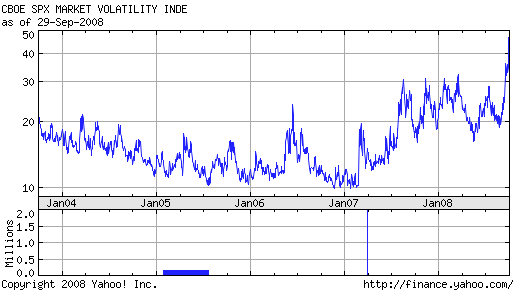
The Chicago Board Options Exchange (CBOE) manages a volatility index called the VIX. The VIX is an excellent indicator of the sentiment, bearish (fearful) or bullish (greedy), in the stock market. It captures the level of uncertainty reflected in option contract premiums. These contracts allow fund managers to insure themselves against sudden share price movements. A high VIX reading indicates investors are fearful and are willing to pay more for this downside protection.

History has shown that when the VIX reaches levels above 25 – 30 (above the red line), it has been a good time to buy. Yesterday the VIX reached nearly 50 and for the last 18 months has regularly reached levels above 25. [Click here for a larger image.]

Click to see larger image

Additionally, we are in a bear market for stocks. The likelihood of precipitous declines from these levels is somewhat low (though not impossible). Given current valuations, U.S. stocks may be the safest place to put money right now. The S&P 500 now trades at 14x earnings estimates for 2008 EPS. This is well below historical PE levels. Another thing to keep in mind is earnings may be somewhat depressed due to a harsh economy. In other words, when earnings return to normal, prices may prove to be even cheaper than it is currently estimated.

High volatility begets cheaper stocks which begets high returns for those who are greedy when others are fearful. 

So what should you do now?

For money you need within 5 years: Keep those funds in an interest bearing account at your bank of choice. Even with all that is going on, the bank is still the best option for your cash funds. If those deposits are below $100,000 ($200,000 in a joint account), they are insured by the FDIC. And the news today is the FDIC is applying to increase those limits. I speculate they will increase them to at least $250,000. 

For money you need beyond 5 years: Invest or keep your money in a diversified (at least 20, no more than 30) portfolio of stocks of low leverage (companies that don’t make use of debt), high return on capital companies. If you have cash available, you should consider adding to your portfolio. Years from now, you will wish you did.

Write your congressman: Write your congressman a letter urging him or her to pass the legislation to infuse $700 billion in the banking system.

Disclosure: I and the clients of Brick Financial Management, LLC owned share of Berkshire Hathaway at the time of this writing.

 Subscribe: Email | Reader | RSS | Audio | IPOD | Mobile Alerts
| Email this Email This | Digg! This Digg | Bookmark to Delicious Delicious | Reddit This Reddit | Search Technorati Technorati | Facebook | Post to MySpace!MySpace! | Print This Print

Subscribe with: 

Subscribe in a readerSubscribe By Email:
-- subscribe to get updated headlines and full length posts delivered right to your email address.


or subscribe by:

Reader | RSS | Audio | IPOD | Mobile

About Brick Financial Management, LLC

Blogged by Brick Financial

51 JFK Pkwy, 1st Fl. West
Short Hills, NJ 07078
973-486-9860
Email Us

Brick Financial Management, LLC is a Registered Investment Advisor specializing in providing investment management services to individuals, families, organizations and institutions. We implement highly focused stock, bond, and balanced portfolios using an investment approach commonly referred to as value investing.

Share

ShareThis -- ShareThis lets you instantly access all of your profiles, blogs, friends, and contacts for easy sharing and updating on sites like Digg, Delicious, Reddit, Facebook and MySpace. For more about ShareThis, click here.

Digg! Digg -- submit this item to be shared and voted on by the digg community. For more about digg, click here.

Delicious Del.icio.us -- mark an item as a favorite to access later or share with the del.icio.us community. For more about del.icio.us, click here.

Facebook Facebook -- share an item with users of Facebook, a collection of school, company and regional social networks. For more about Facebook, click here.

Ben's Latest Tweet

    Follow Ben on Twitter

    Archives